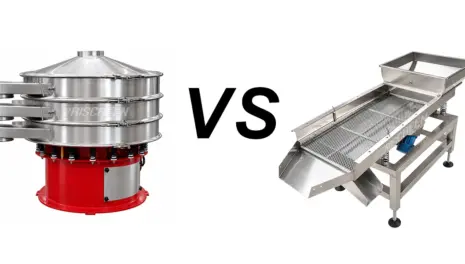
A vibrating screen is a screening machine used to separate powders, granules, and bulk materials according to particle size. It is widely used in industries such as food processing, chemical production, mineral processing, and advanced material manufacturing.
But how does a vibrating screen work?
The basic principle is simple. A vibrating motor generates mechanical vibration, causing the screen body and material to move. As the material travels across the screen mesh, smaller particles pass through the openings while larger particles remain on the screen and move toward the discharge outlet.
Understanding this working principle is important when selecting the right screening equipment for your material.
What Is a Vibrating Screen?
A vibrating screen is a mechanical screening machine that uses vibration to separate materials by particle size.
When mixed material enters the screening surface, vibration causes the particles to move and spread across the screen. Smaller particles can pass through the mesh openings, while oversized particles remain above the screen.
Depending on the machine design, a vibrating screen can be used for:
- Particle size separation
- Powder screening
- Granule classification
- Impurity removal
- Fine powder screening
- Multi-size classification
Different types of vibrating screens are designed for different materials and production requirements.
How Does a Vibrating Screen Work?
The working process of a vibrating screen can be divided into five basic steps.
1. Material Feeding
The material enters the screening machine through the feed inlet.
For good screening performance, the material should be distributed evenly across the screen surface. An uneven or excessive feed can reduce the effective screening area and affect separation efficiency.
2. Vibration
The vibrating motor generates the mechanical force required to move the screen body.
As the motor operates, its eccentric weights create centrifugal force. This causes the screen to vibrate at a controlled frequency and amplitude.
The vibration loosens the material and keeps particles moving across the screen mesh.
3. Material Stratification
As the material moves, particles begin to separate according to size.
Larger particles generally remain toward the upper part of the material layer, while smaller particles move downward toward the screen surface.
This process is called particle stratification.
Good stratification gives smaller particles more opportunities to contact the screen openings.
4. Screening
Once particles reach the screen surface, particles smaller than the mesh openings can pass through.
In simple terms:
Fine particles → Pass through the mesh
Oversized particles → Remain on the screen
The size of the screen openings determines the separation point.
5. Discharge
After screening, the separated materials move toward their respective discharge outlets.
In a single-layer machine, the process can separate material into undersize and oversize fractions.
With multiple screen layers, one machine can separate material into several particle-size ranges.
What Are the Main Components of a Vibrating Screen?
Although vibrating screens are available in different designs, most machines contain several basic components.
Vibrating Motor
The vibrating motor generates the mechanical force that drives the screening process.
The motor and vibration parameters should be selected according to the machine size, material characteristics, and required screening performance.
Screen Mesh
The screen mesh is the main separation surface.
Its opening size determines which particles can pass through. Different materials and separation requirements may require different mesh sizes and mesh types.
Screen Frame
The screen frame supports the screen mesh and helps maintain the structure of the screening surface during operation.
Feed and Discharge Outlets
The feed inlet introduces material into the machine, while discharge outlets remove the separated fractions.
The number and design of outlets depend on the machine configuration and screening process.
What Factors Affect Vibrating Screen Performance?
Vibration alone does not determine screening efficiency. Several factors work together to affect the final result.
Particle Size
The particle size distribution of the material determines how easily particles can pass through the screen openings.
Screen Mesh Size
The mesh opening must match the required separation point. A suitable mesh size is essential for achieving the desired screening accuracy.
How to Choose the Right Vibrating Screen Mesh Size?
Feed Rate
If too much material enters the machine at once, the material layer can become too thick. This can reduce the opportunity for fine particles to contact the screen surface.
Material Characteristics
Moisture, particle shape, bulk density, flowability, stickiness, and abrasiveness can all affect screening performance.
For this reason, the same vibrating screen may perform differently with different materials.
What Types of Vibrating Screens Are Available?
Different vibrating screen designs use different movement patterns and are suitable for different applications.
Common types include:
- Rotary Vibrating Screen – widely used for powders, granules, and fine particle separation.
- Linear Vibrating Screen – suitable for continuous conveying, grading, and higher-throughput applications.
- Ultrasonic Vibrating Screen – designed for fine powders that may cause mesh blockage.
- Tumbler Screener – uses a gyratory screening motion for applications requiring high screening accuracy.
Each type has its own advantages depending on the material, particle size, capacity, and screening requirements.
What Are the Different Types of Vibrating Screens?
What Materials Can a Vibrating Screen Handle?
Vibrating screens can be used for many types of powders, granules, and bulk materials.
Common examples include:
- Flour
- Starch
- Sugar
- Salt
- Coffee powder
- Quartz sand
- Silica sand
- Calcium carbonate
- Graphite powder
- Resin powder
- Pigment powder
- Metal powders
The appropriate machine depends on the material characteristics, required particle size, capacity, and screening objective.
For material-specific applications, see our guides on Vibrating Screen for Flour, Vibrating Screen for Quartz Sand, and Vibrating Screen for Graphite Powder.
Conclusion
A vibrating screen works by combining mechanical vibration, screen mesh, and controlled material movement to separate particles according to size.
The vibrating motor creates the required motion, while the screen mesh determines which particles can pass through. As the material moves across the screen, particles are separated and discharged according to their size.
Choosing the right vibrating screen requires consideration of material characteristics, particle size, mesh size, feed rate, capacity, and screening requirements.
If you are not sure which screening machine is suitable for your material, provide us with your material type, particle size, and required capacity, and our engineers can recommend a suitable screening solution.
Frequently Asked Questions
How does a vibrating screen separate materials?
A vibrating screen uses mechanical vibration to move material across a screen mesh. Smaller particles pass through the mesh openings, while larger particles remain on the screen and move toward the discharge outlet.
What is the main purpose of a vibrating screen?
A vibrating screen is mainly used for particle size separation, classification, powder screening, and impurity removal.
Can a vibrating screen handle fine powder?
Yes. Vibrating screens can handle many fine powders. For very fine materials that tend to block the mesh, an ultrasonic vibrating screen may be a suitable option.
Can a vibrating screen have multiple layers?
Yes. Multiple screening layers can be installed to separate material into several particle-size fractions in a single screening process.