Rotary Vibrating Screen vs Linear Vibrating Screen: Which One Is Right for Your Application?
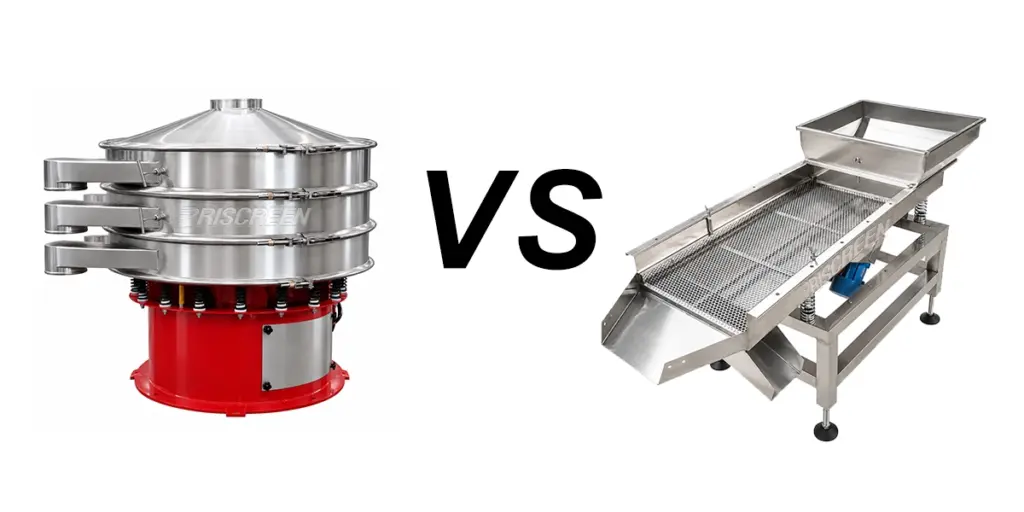
When choosing a vibrating screen for powder, granules, or bulk materials, two of the most common options are the rotary vibrating screen and the linear vibrating screen.
Although both machines use vibration to separate materials by particle size, they are designed for different screening requirements. The right choice depends on factors such as material characteristics, screening accuracy, capacity, number of separation fractions, moisture content, and application.
So, Rotary Vibrating Screen vs Linear Vibrating Screen — which one should you choose?
This guide explains the key differences between rotary and linear vibrating screens and helps you select the right screening machine for your application.
What Is a Rotary Vibrating Screen?
A rotary vibrating screen, also called a circular vibrating sieve or rotary vibro sifter, is a compact screening machine designed primarily for precise separation of powders and fine particles.
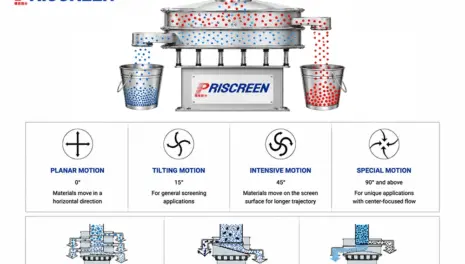
The machine uses a vertical vibration motor to generate three-dimensional vibration. This causes the material to move across the screen surface in a circular motion.
How Does a Rotary Vibrating Screen Work?
Material is fed into the center of the upper screen. Under the action of vibration, the material spreads across the screen surface.
Fine particles pass through the mesh openings, while oversized particles move toward the discharge outlet.
Depending on the number of screen layers, one machine can separate materials into multiple particle-size fractions.
For example:
One layer: 2 fractions
Two layers: 3 fractions
Three layers: 4 fractions
This makes rotary vibrating screens suitable for applications where high screening accuracy and flexible separation are required.
What Is a Linear Vibrating Screen?
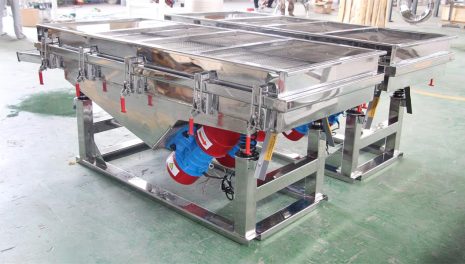
A linear vibrating screen uses two vibration motors to generate a linear vibration trajectory.
The material moves forward along the screen surface while particles smaller than the mesh openings pass through the screen.
How Does a Linear Vibrating Screen Work?
Material enters the screen from the feed inlet and moves continuously toward the discharge end.
The linear vibration helps transport the material while simultaneously separating particles according to size.
Because the material moves in a relatively straight path, linear vibrating screens are particularly suitable for high-capacity screening and continuous material handling.
Rotary Vibrating Screen vs Linear Vibrating Screen: Key Differences
The biggest difference between these two machines is their motion pattern and application focus.
| Feature | Rotary Vibrating Screen | Linear Vibrating Screen |
|---|---|---|
| Vibration motion | Circular / three-dimensional | Linear |
| Main application | Fine and precise screening | High-capacity screening |
| Typical materials | Powders and fine granules | Granules and bulk materials |
| Screening accuracy | High | Medium to high |
| Capacity | Low to medium | Medium to high |
| Fine powder screening | Excellent | Good |
| Multiple fractions | Excellent | Good |
| Material transportation | Moderate | Excellent |
| Compact design | Yes | Requires more installation space |
| Dust control | Easy to enclose | Can be enclosed |
| Wet material | Limited depending on design | More suitable with proper configuration |
| Screen cleaning | Easy to add cleaning systems | Depends on design |
| Typical industries | Food, chemical, powder processing | Mining, aggregates, agriculture, bulk materials |
1. Screening Motion
The most obvious difference is the vibration trajectory.
Rotary Vibrating Screen
A rotary vibrating screen produces a three-dimensional circular vibration.
This allows material to move across the screen surface in multiple directions, increasing the contact between the material and screen mesh.
This is particularly useful for:
- Fine powders
- Small particle sizes
- High-precision screening
- Removing oversized particles
- Separating several particle sizes
Linear Vibrating Screen
A linear vibrating screen produces a straight-line vibration.
The material moves forward while being screened, which provides excellent conveying performance.
It is therefore more suitable when the process requires:
- Continuous feeding
- High throughput
- Long-distance material movement
- Large-volume screening
2. Screening Accuracy
If screening accuracy is the primary concern, the rotary vibrating screen is generally the better choice.
The circular vibration allows material to repeatedly contact the screen mesh, improving the probability that particles will pass through the correct openings.
This makes rotary vibrating screens widely used for:
- Flour
- Sugar
- Starch
- Milk powder
- Coffee powder
- Spice powder
- Chemical powders
- Pigment powder
- Graphite powder
For applications where the main goal is precise particle-size classification, a rotary vibrating screen is often preferred.
3. Screening Capacity
When it comes to large-volume material handling, a linear vibrating screen generally has an advantage.
The linear motion provides strong material transportation and allows material to move continuously from the feed end to the discharge end.
Linear vibrating screens are commonly used for:
- Sand
- Gravel
- Quartz
- Silica sand
- Coal
- Mineral materials
- Plastic granules
- Agricultural materials
For high-capacity applications, the machine can be designed with a larger screening area and multiple screen decks.
4. Powder Screening
For fine powder screening, the rotary vibrating screen is usually the preferred solution.
Its compact structure and circular vibration make it suitable for fine powders that require accurate separation.
Typical applications include:
Food Powder
- Flour
- Sugar
- Starch
- Milk powder
- Coffee powder
- Cocoa powder
- Matcha powder
- Spice powder
Chemical Powder
- Resin powder
- PVC powder
- Pigment powder
- Titanium dioxide
- Calcium carbonate
- Activated carbon
New Energy Materials
- Graphite powder
- Conductive carbon
- Metal powder
- Lithium battery materials
For extremely fine powders, additional screen-cleaning systems such as ultrasonic screening systems can be considered.
5. Granular and Bulk Material Screening
Linear vibrating screens are often more suitable for larger particles and high-volume granular materials.
Typical materials include:
- Quartz sand
- Silica sand
- Frac sand
- Plastic granules
- Fertilizer
- Agricultural grains
- Mineral particles
The linear motion helps transport these materials efficiently through the screening machine.
6. Number of Screening Fractions
Both types of vibrating screens can be manufactured with multiple screen decks.
However, rotary vibrating screens are particularly flexible for applications requiring multiple particle-size classifications in a compact machine.
For example, a three-layer rotary vibrating screen can separate material into four different fractions.
The final configuration depends on:
- Required particle size
- Mesh size
- Material characteristics
- Capacity
- Number of fractions
- Installation requirements
7. Space Requirements
A rotary vibrating screen generally has a compact circular structure, making it suitable for plants where installation space is limited.
Linear vibrating screens normally have a longer rectangular structure because the material needs to travel from the feeding end to the discharge end.
Therefore:
Limited installation space → Rotary Vibrating Screen
Long conveying distance / large screening area → Linear Vibrating Screen
Rotary Vibrating Screen or Linear Vibrating Screen: Which One Should You Choose?
The easiest way to select the right machine is to start with your material and screening objective.
Choose a Rotary Vibrating Screen If:
You should consider a rotary vibrating screen when:
- You need high screening accuracy
- You are screening fine powders
- Your material is relatively dry
- You need multiple particle-size fractions
- You have limited installation space
- You need a compact screening machine
- You are processing food powders
- You are processing chemical powders
- You need easy screen replacement and maintenance
Typical applications include flour, sugar, starch, milk powder, coffee powder, spices, graphite powder, calcium carbonate, pigment powder, and other fine powders.
Choose a Linear Vibrating Screen If:
A linear vibrating screen may be a better choice when:
- High capacity is the priority
- Material needs to be continuously transported
- You are screening granular or bulk materials
- The material contains relatively large particles
- A long screening surface is required
- You need efficient material conveying
Typical applications include quartz sand, silica sand, minerals, coal, fertilizer, plastic granules, and agricultural materials.
Can a Rotary Vibrating Screen and Linear Vibrating Screen Be Used for the Same Material?
Yes.
The same material can sometimes be screened using either machine.
For example, quartz sand can be processed using a rotary vibrating screen when accurate particle-size classification is required. A linear vibrating screen may be preferred when the main requirement is high-capacity continuous screening.
Therefore, material type alone is not enough to select the machine.
You should also consider:
- Material particle size
- Moisture content
- Required screening accuracy
- Processing capacity
- Number of fractions
- Screen mesh size
- Feeding method
- Installation space
- Final application
Rotary Vibrating Screen vs Linear Vibrating Screen: Quick Selection Guide
A simple rule of thumb is:
Fine powder + high precision → Rotary Vibrating Screen
Multiple particle-size fractions + compact design → Rotary Vibrating Screen
Large capacity + continuous conveying → Linear Vibrating Screen
Granular materials + high throughput → Linear Vibrating Screen
Limited installation space → Rotary Vibrating Screen
Large bulk materials → Linear Vibrating Screen
However, actual machine selection should always be based on the material and process requirements.
Frequently Asked Questions
Is a rotary vibrating screen better than a linear vibrating screen?
Neither machine is universally better.
A rotary vibrating screen is generally better for fine powder screening and high-precision separation, while a linear vibrating screen is generally better for high-capacity screening and continuous material transportation.
The best choice depends on your application.
Which vibrating screen is better for powder?
For most dry fine powder applications, a rotary vibrating screen is a strong choice because it provides accurate screening in a compact design.
For extremely fine powders, an ultrasonic cleaning system can also be added to reduce mesh blockage and improve screening performance.
Which vibrating screen has higher capacity?
A linear vibrating screen generally offers higher capacity for large-volume granular and bulk materials.
However, the actual capacity depends on screen area, material characteristics, mesh size, feeding rate, moisture content, and machine configuration.
Can a rotary vibrating screen screen multiple sizes?
Yes.
A rotary vibrating screen can be equipped with multiple screen layers to separate material into several particle-size fractions.
Can a linear vibrating screen screen powder?
Yes. Linear vibrating screens can process certain powders, especially when the application requires continuous conveying and relatively high capacity.
However, for fine powders requiring high screening accuracy, a rotary vibrating screen may be more suitable.
Final Verdict: Rotary Vibrating Screen vs Linear Vibrating Screen
The choice between a rotary vibrating screen and a linear vibrating screen should be based on the actual screening process rather than simply comparing machine specifications.
Choose a rotary vibrating screen when your priority is:
High precision + fine powder + multiple separation fractions + compact design
Choose a linear vibrating screen when your priority is:
High capacity + continuous conveying + granular materials + bulk screening
If you are unsure which vibrating screen is suitable for your material, provide your material name, particle size, required capacity, moisture content, and desired screening mesh. A suitable screening solution can then be recommended based on your actual process requirements.
Looking for the right vibrating screen for your application? Contact us with your material and capacity requirements for a customized screening solution.